
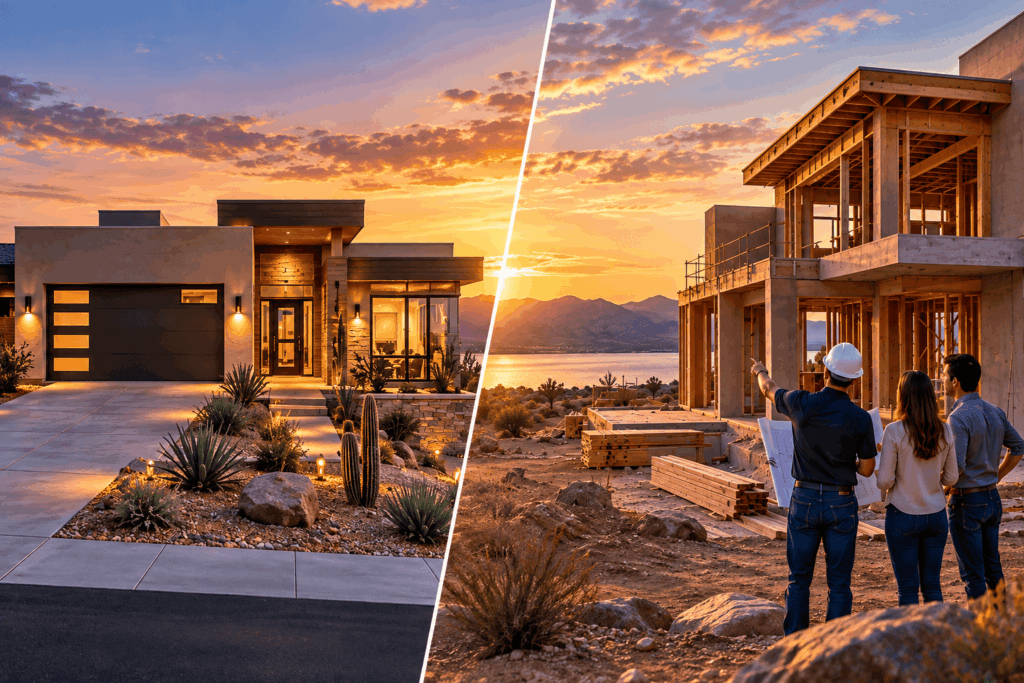
Choosing the Right Residential Development Strategy
When evaluating residential real estate development opportunities, one of the most important decisions is determining what type of home to build. Two common approaches are speculative homebuilding, commonly known as spec homes, and custom home construction.
Both strategies can create attractive residential properties, but they differ significantly in terms of financial risk, construction timelines, buyer involvement, design flexibility, and capital requirements.
For developers and investors in Arizona, understanding these differences is essential to selecting a strategy that aligns with market demand and investment objectives.
In lifestyle-driven markets such as Lake Havasu City, buyers may be seeking everything from move-in-ready luxury residences to personalized homes designed around their individual preferences. Each buyer segment creates distinct opportunities for residential development.
At APX West, we recognize that successful homebuilding begins with understanding the intended buyer, evaluating development economics, and selecting a construction approach that supports the project’s overall goals.
What Is a Spec Home?
A spec home is a residential property developed and constructed without a specific buyer committed to purchasing it at the beginning of the project.
The developer selects the lot, floor plan, architectural style, finishes, and features based on anticipated market demand.
The completed home is then marketed to prospective buyers, although it may sell before construction is finished.
Speculative homebuilding allows developers to maintain control over design decisions and construction schedules while creating a finished product intended to appeal to a defined buyer segment.
Spec homes can range from entry-level residences to high-end luxury properties.
In Arizona, luxury spec homes may incorporate open floor plans, expansive garages, outdoor entertaining areas, contemporary architecture, and design features suited to desert living.
Developers interested in this residential category can explore APX West’s luxury spec homes to see how thoughtfully designed, market-oriented housing fits into our broader development approach.
What Is a Custom Home?
A custom home is designed and built around the preferences, requirements, and budget of a specific buyer.
Unlike a spec home, where the developer makes most design decisions independently, custom construction typically involves substantial homeowner participation.
Buyers may influence the architectural layout, room dimensions, materials, finishes, and specialized features.
This flexibility allows homeowners to create properties that reflect their individual lifestyles.
However, custom construction often requires additional coordination between architects, engineers, contractors, designers, and the homeowner.
Design revisions, specialized materials, and personalized features can also affect budgets and construction schedules.
For developers, the primary difference is that a custom home generally begins with an identified client, while a spec home begins with an assessment of anticipated market demand.
1. Buyer Demand and Market Positioning
The first consideration when comparing spec homes vs. custom homes is understanding the target market.
Speculative homebuilding depends heavily on the developer’s ability to anticipate what prospective buyers want.
Floor plans, finishes, square footage, and pricing must appeal to a sufficiently broad audience to support a successful sale.
A well-positioned spec home should reflect local buyer preferences without becoming so specialized that it limits potential demand.
Custom homes operate differently.
Because the buyer is typically involved from the beginning, the project is designed around an established set of requirements rather than general market preferences.
This can reduce uncertainty about who the finished home is intended to serve, although financing, contract terms, and construction execution remain important considerations.
For investors, spec home development requires particularly strong market research because capital may be committed before a purchaser has been secured.
2. Construction Timelines and Project Efficiency
Construction timelines can vary significantly between speculative and custom homebuilding.
Spec homes may benefit from a more streamlined process because major design decisions are established before construction begins.
Developers can finalize architectural plans, select materials, coordinate subcontractors, and establish construction schedules without waiting for ongoing homeowner approvals.
When multiple homes use similar floor plans or specifications, developers may also benefit from repeated construction processes and more consistent purchasing requirements.
Custom homes can involve longer preconstruction periods because buyers may need additional time to evaluate design options, approve plans, and select finishes.
Changes requested during construction can further affect scheduling.
However, spec homes are not automatically completed faster. Permitting requirements, site conditions, material availability, and contractor capacity can influence either approach.
The key advantage of speculative construction is the opportunity to standardize decisions and reduce unnecessary complexity.
3. Design Flexibility and Personalization
One of the clearest differences between spec homes and custom homes is the degree of personalization available to the buyer.
Custom homes offer the greatest flexibility because the property can be designed around individual preferences from the beginning.
Buyers may prioritize specialized layouts, unique architectural details, or features that would not necessarily appeal to the broader market.
Spec homes generally provide less flexibility because design selections are made by the developer.
This can be attractive to buyers who prefer a professionally designed, move-in-ready home without managing an extensive construction process.
Between these two approaches is another option: semi-custom homebuilding.
Semi-custom homes typically offer a selection of established floor plans, architectural features, or finish packages that allow buyers to personalize certain aspects of the home while retaining a more structured construction process.
This approach can provide a balance between customization and efficiency.
APX West’s semi-custom homes reflect this middle-ground strategy, offering buyers an alternative to fully speculative or completely custom construction.
4. Capital Requirements and Financial Exposure
From an investment perspective, capital requirements represent one of the most important distinctions between the two development models.
In speculative homebuilding, the developer generally finances land acquisition, construction, and associated carrying costs before receiving the proceeds from a completed sale.
This creates exposure to changes in market demand, financing expenses, and property values during the development period.
If the home takes longer than expected to sell, the developer may incur additional interest, taxes, insurance, maintenance, and marketing expenses.
Custom construction often follows a different financial structure.
Depending on the contract, the buyer may own the lot, secure construction financing, and make payments as the project progresses.
This can reduce certain inventory-related risks for the builder, although payment schedules, cost overruns, contractual obligations, and client changes must still be managed carefully.
Neither approach eliminates financial risk.
Developers must evaluate available capital, financing terms, projected margins, and the consequences of potential delays before selecting a strategy.
5. Inventory Risk and Market Conditions
Inventory risk is a defining consideration in speculative homebuilding.
Because the property may be completed before a buyer is secured, the developer must be prepared to hold the home until it sells.
Market conditions can change during construction.
Interest rates, buyer confidence, competing inventory, and local economic trends may all influence demand.
For this reason, spec home developers should evaluate comparable sales, active listings, new construction inventory, and realistic absorption periods.
The U.S. Census Bureau New Residential Construction data provides information on housing starts, building permits, and completions that can help investors understand broader construction activity.
Although national and regional data cannot replace local market research, it can provide useful context when evaluating residential development trends.
Custom homebuilding generally carries less unsold-inventory exposure when a binding construction agreement is in place, but it introduces other considerations, including client financing, contract administration, and the management of individualized expectations.
6. Cost Control and Construction Standardization
Speculative homebuilding can offer advantages in construction cost management.
When developers use established floor plans, consistent material specifications, and repeatable construction methods, they may be able to improve purchasing efficiency and reduce design-related changes.
Standardization can also help subcontractors become familiar with recurring building requirements.
These efficiencies are particularly relevant when constructing multiple homes within the same development.
Custom homes, by comparison, may require specialized materials, unique architectural features, and additional coordination.
Such features can increase complexity and make budgeting less predictable.
However, custom projects may also command higher contract values when buyers are willing to pay for specialized design and finishes.
The objective is not necessarily to minimize construction spending, but to ensure that costs are appropriate for the intended product and supported by the market.
APX West’s construction services emphasize coordinated execution, helping connect design decisions, project budgets, and construction requirements.
7. Marketing and Sales Considerations
Spec homes and custom homes also require different marketing strategies.
A spec home is a defined real estate product that must compete with other available properties.
Its presentation, pricing, location, design, and features all influence how prospective buyers perceive its value.
Professional photography, compelling property descriptions, and a clear understanding of buyer preferences can play important roles in positioning the finished home.
Custom homebuilding is more service-oriented.
Rather than selling an existing property, the builder is often marketing expertise, craftsmanship, design flexibility, and the ability to deliver a personalized construction experience.
Semi-custom homes may combine elements of both approaches, promoting an established product while highlighting available personalization options.
For developers, aligning the marketing strategy with the construction model helps establish appropriate buyer expectations and supports more effective sales planning.
8. Evaluating the Potential Return on Investment
Neither speculative nor custom homebuilding is inherently more profitable.
Potential returns depend on land acquisition costs, construction expenses, financing, selling prices, project duration, and market conditions.
Spec home investors may benefit when a property is completed efficiently and sold at a price that supports the development budget.
However, delays in selling completed inventory can reduce profitability through additional carrying costs.
Custom builders may benefit from a defined client relationship and contractual payment structure, but project profitability can be affected by estimating accuracy, scope changes, and execution challenges.
The National Association of Home Builders provides industry research and resources covering construction costs, housing markets, and homebuilding economics.
Developers should use relevant market data alongside project-specific financial modeling to evaluate which strategy offers the most appropriate balance of risk and potential return.
9. Choosing the Right Strategy for the Arizona Market
In Arizona, residential development strategies should reflect the characteristics of each local market.
Some buyers prioritize convenience and prefer a completed home they can purchase without waiting through a construction process.
Others value the ability to personalize their residence, particularly when building a long-term primary home or distinctive luxury property.
Land characteristics also influence the appropriate approach.
A property with unique views, challenging topography, or specialized architectural potential may be suited to a different product than a subdivision designed around repeated floor plans.
Developers should consider the intended buyer, available inventory, construction costs, pricing expectations, and the time required to bring the home to market.
A successful strategy aligns these factors before substantial capital is committed.
Build With a Strategy That Matches the Market
The decision between spec homes and custom homes is ultimately a question of development objectives, buyer demand, and financial feasibility.
Speculative homebuilding offers opportunities for design consistency, construction efficiency, and market-driven residential inventory. Custom construction provides greater personalization and typically begins with an identified buyer. Semi-custom homes offer an alternative that combines structured design with selected customization opportunities.
For developers and investors, understanding these trade-offs is essential to creating residential properties that meet market expectations while supporting realistic project economics.
Considering a residential development opportunity in Arizona? Connect with APX West to discuss how our experience in luxury spec homes, semi-custom residences, and coordinated construction can help you identify the right strategy for your property and investment goals.