
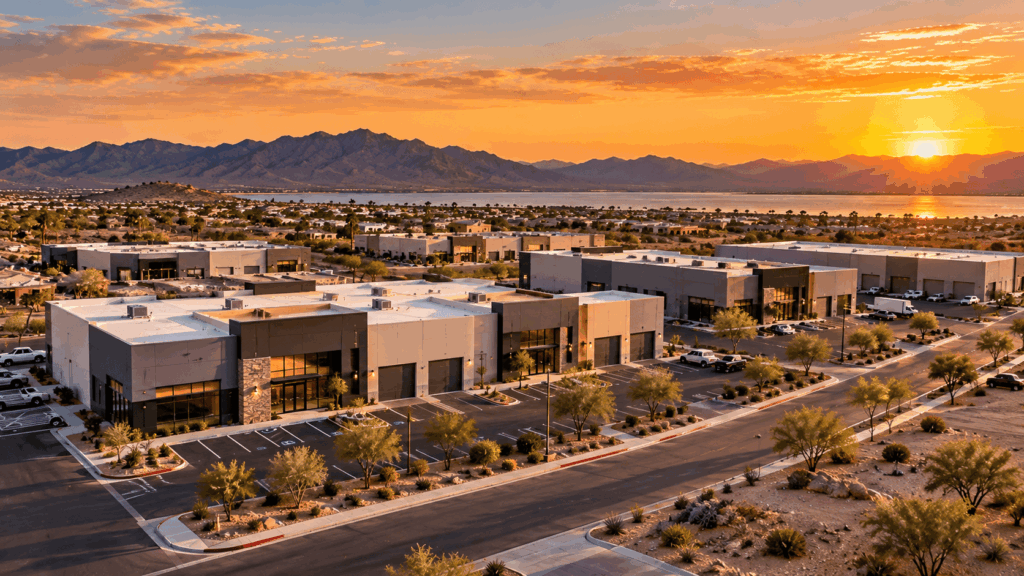
Why Commercial Business Parks Matter to Growing Communities
Economic development depends on more than attracting new residents and building homes. Communities also need places where businesses can establish operations, expand their services, hire employees, and contribute to the local economy.
Commercial business parks play an important role in supporting these activities by providing dedicated spaces for businesses across a range of industries.
From small service companies and professional offices to warehousing, distribution, and light industrial operations, business parks can accommodate employers whose space requirements may not fit traditional retail or office environments.
For growing Arizona communities, including Lake Havasu City and surrounding areas, strategically planned commercial developments can support business expansion, employment opportunities, and long-term economic activity.
At APX West, we view commercial business park development as an opportunity to create functional real estate assets that respond to local business needs while contributing to broader regional growth.
What Is a Commercial Business Park?
A commercial business park is a planned development designed to accommodate multiple businesses within a coordinated property or group of buildings.
Unlike a traditional shopping center, which primarily serves consumer-facing retail businesses, a commercial business park may support a broader range of uses.
Depending on zoning, building configuration, and local market demand, tenants may include:
- Professional service companies
- Contractors and trade businesses
- Equipment suppliers
- Warehousing and distribution operations
- Light manufacturing businesses
- Automotive-related service providers
- Small businesses requiring office and storage space
Some business parks feature flexible commercial units that allow businesses to combine several functions within one property.
For example, a contractor may need administrative office space, secure equipment storage, and convenient access for work vehicles.
A flexible commercial unit may accommodate these requirements more efficiently than a conventional office building.
This adaptability can make business parks an important component of a community’s commercial real estate inventory.
1. Creating Space for Local Business Growth
One of the primary benefits of commercial business parks is their ability to provide businesses with room to grow.
Small companies frequently begin operations in home offices, rented storage units, or facilities that were not originally designed for their needs.
As these businesses expand, they may require dedicated commercial space with appropriate utilities, parking, loading access, and operational flexibility.
Without suitable properties available locally, business owners may be forced to operate from inefficient locations or consider relocating to neighboring communities.
Commercial business parks can help address this challenge by offering purpose-built environments for a range of business activities.
Well-designed developments may also allow companies to expand within the same business park as their space requirements change.
For communities, retaining growing businesses can support local employment, commercial activity, and demand for supporting services.
2. Supporting Job Creation and Employment Opportunities
Commercial real estate development can influence employment in several ways.
During construction, projects generate demand for contractors, subcontractors, engineers, suppliers, and other professional services.
Once completed, the properties provide space for businesses that may employ local workers.
The number and type of jobs created depend on the tenants, industries, and scale of the development.
A professional services company may have different staffing requirements than a distribution business or light manufacturing operation.
However, the availability of suitable commercial space can be an important consideration for employers evaluating where to establish or expand operations.
The U.S. Bureau of Labor Statistics provides employment and industry data that developers can use to better understand regional labor market conditions.
By studying employment trends and local business activity, developers can make more informed decisions about the types of commercial properties a market may need.
3. Strengthening the Local Business Ecosystem
Business parks can create opportunities for companies to operate near complementary services and suppliers.
For example, construction-related businesses may benefit from proximity to equipment suppliers, material distributors, and specialized service providers.
Similarly, logistics companies may value locations near transportation routes and businesses that depend on regular deliveries.
This concentration of commercial activity can create practical efficiencies.
Businesses may reduce travel time between suppliers and customers, improve coordination, and gain easier access to services needed for daily operations.
Commercial developments can also help establish recognizable business districts, making it easier for customers and vendors to locate companies.
These benefits depend on the actual mix of tenants and how well the property is designed to accommodate their needs.
Successful business park planning therefore requires more than simply constructing commercial buildings. It requires understanding how prospective occupants operate.
4. Location and Accessibility Are Critical
Location is one of the most important factors influencing the success of a commercial business park.
Businesses need convenient access for employees, customers, deliveries, and service vehicles.
Depending on the intended tenant mix, proximity to major roads, transportation corridors, established commercial districts, and residential neighborhoods may influence demand.
For warehouse and light industrial tenants, vehicle circulation and loading access can be particularly important.
Developers should evaluate roadway capacity, turning movements, parking requirements, and the ability of larger vehicles to enter and exit the property safely.
A site that appears attractive based on land cost alone may prove less suitable if access limitations create operational challenges.
In Arizona, site selection should also account for terrain, drainage, utility availability, and potential infrastructure improvements.
These factors can influence both construction expenses and the property’s long-term functionality.
Through our real estate planning services, APX West evaluates development opportunities with attention to site characteristics, intended uses, and the practical requirements of creating functional commercial properties.
5. The Growing Appeal of Flexible Commercial Space
One commercial development format worth considering is flex space.
Flex commercial properties are designed to accommodate multiple business functions, often combining office, warehouse, storage, showroom, or light industrial areas.
These properties can be particularly useful for businesses whose operational needs do not fit neatly into a single traditional commercial category.
Features may include roll-up doors, flexible interior layouts, dedicated parking, high ceilings, and accessible loading areas.
The specific configuration depends on the intended users and applicable zoning requirements.
For developers, flexibility may expand the range of potential tenants or purchasers.
However, adaptable design should still be informed by market research. A building intended to serve too many different uses may become unnecessarily expensive or fail to meet the specialized requirements of any particular tenant group.
The objective is to create commercial space that responds to identifiable business needs while allowing reasonable adaptability over time.
APX West’s Lake Havasu Avenue Business Park illustrates our focus on developing flexible commercial properties designed around the operational needs of businesses in the Lake Havasu market.
6. How Business Parks Can Support Nearby Residential Demand
Commercial and residential development are closely connected.
As businesses establish operations and expand their workforces, employees may seek housing within a practical commuting distance.
This relationship can contribute to demand for nearby residential properties, particularly in communities where employment centers and housing options are not well aligned.
Business parks can also generate demand for local restaurants, retail stores, professional services, and other amenities used by employees and business owners.
However, the relationship between commercial development and residential demand is not automatic.
A business park occupied primarily by storage users may have a different employment impact than one occupied by companies with larger workforces.
Developers should evaluate the expected tenant mix and local economic conditions rather than assuming that every commercial project will produce substantial housing demand.
When supported by genuine market needs, coordinated residential and commercial development can contribute to a more balanced regional economy.
7. Infrastructure Planning Determines Long-Term Functionality
Commercial business parks require infrastructure designed around their intended uses.
Road access, electrical capacity, water and sewer service, telecommunications, drainage, and parking all influence how effectively tenants can operate.
Certain businesses may require higher electrical capacity, specialized loading areas, or additional utility infrastructure.
These needs should be considered during the earliest stages of project design.
For example, a property intended for warehouse and contractor use may require different circulation patterns and pavement specifications than a development primarily serving professional offices.
In desert environments, grading and stormwater management also play important roles in protecting buildings, roadways, and surrounding properties.
APX West’s engineering services support the evaluation and design of infrastructure necessary to transform commercial land into usable development sites.
Early coordination between planning and engineering teams can help reduce conflicts and establish more realistic project budgets.
8. Evaluating Tenant Demand Before Construction
A successful commercial business park should be developed around a clear understanding of potential occupants.
Before committing capital, developers should research existing commercial inventory, vacancy rates, asking rents, sale prices, and the types of spaces local businesses are seeking.
Interviews with brokers, business owners, and prospective tenants may provide additional insight into unmet market needs.
For example, demand for smaller contractor units may differ significantly from demand for large industrial warehouses.
Building dimensions, parking ratios, loading access, and interior flexibility should reflect the requirements of the target market.
The U.S. Small Business Administration provides resources and information about small businesses that can help inform a broader understanding of the business environment.
While national business data offers useful context, local market research remains essential.
Developers should avoid relying solely on general commercial real estate trends when making decisions about a specific property.
9. Business Parks as Long-Term Real Estate Investments
Commercial business parks can offer different investment opportunities depending on how the development is structured.
Some developers construct units for individual sale, while others retain ownership and lease space to businesses.
Each strategy carries distinct financial considerations.
Properties intended for sale require careful analysis of buyer demand, pricing, development costs, and expected absorption periods.
Income-producing properties require additional evaluation of rental rates, vacancy assumptions, operating expenses, maintenance, and tenant creditworthiness.
Flexibility can be valuable, but it does not eliminate market risk.
A development must still offer the right combination of location, building functionality, pricing, and operating economics to attract occupants.
For investors, disciplined financial modeling is essential to understanding whether projected revenue supports the cost of acquiring, improving, and constructing the property.
10. Why Integrated Development Matters
Commercial business park development requires coordination across land acquisition, planning, engineering, construction, and marketing.
Decisions made during one phase can significantly affect the next.
For example, an early site layout that does not adequately account for truck circulation may require expensive revisions during engineering.
Similarly, a building design that overlooks tenant utility requirements may limit the property’s marketability after construction.
A coordinated development strategy helps align the physical property with financial objectives and anticipated business demand.
By evaluating these considerations early, developers can identify potential challenges before they affect construction schedules or budgets.
At APX West, we approach commercial real estate development with an emphasis on practical site planning, coordinated execution, and long-term property functionality.
Creating Commercial Spaces That Move Communities Forward
Commercial business parks are more than collections of buildings. They provide the physical space businesses need to operate, expand, and contribute to their local economies.
When thoughtfully planned, these developments can support entrepreneurship, employment opportunities, and demand for surrounding services while creating valuable commercial real estate assets.
For Arizona communities experiencing economic and residential growth, the right commercial infrastructure can help businesses establish a stronger foundation for the future.
Exploring a commercial development or land investment opportunity in Arizona? Connect with APX West to discuss how our expertise in planning, engineering, and commercial real estate development can help transform your vision into a functional, market-driven business property.