
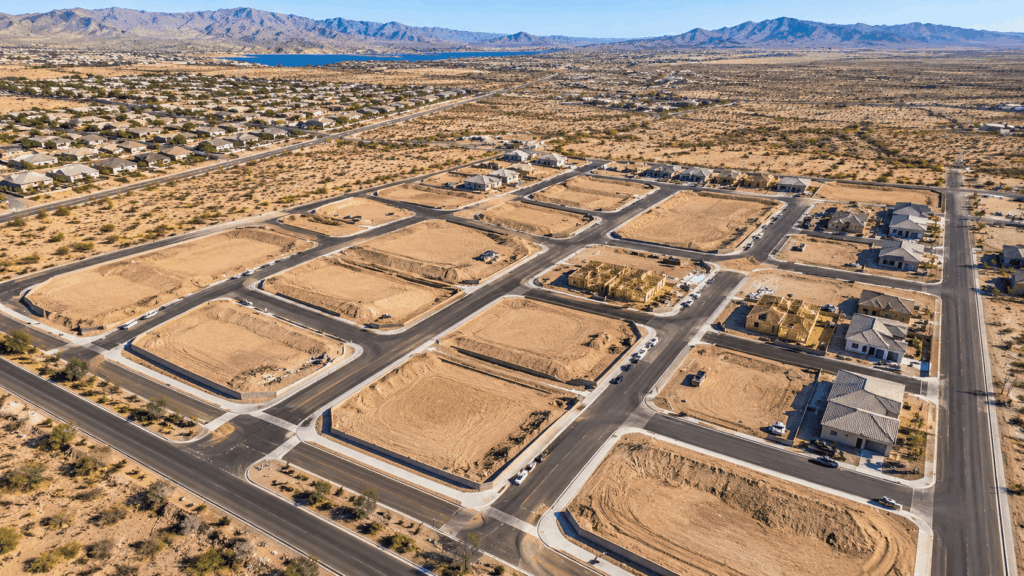
Understanding the True Cost of Land Development
Land development can be one of the most rewarding opportunities in real estate investment, but understanding the full financial commitment is essential before purchasing a property. While the acquisition price is often the most visible expense, it represents only one component of the total investment.
Successful land development requires a comprehensive budget that accounts for engineering, infrastructure, permitting, construction, financing, and ongoing carrying costs. Overlooking any of these expenses can affect project feasibility, delay completion, and reduce potential returns.
For investors evaluating opportunities in Arizona, particularly in growing markets such as Lake Havasu City and Mohave County, understanding land development costs is a critical first step toward making informed investment decisions.
At APX West, we approach real estate development with a focus on financial feasibility, strategic planning, and coordinated execution. Understanding the complete development lifecycle allows investors to evaluate opportunities based on realistic costs rather than acquisition price alone.
1. Land Acquisition: More Than the Purchase Price
Every development begins with acquiring the right property. However, the cost of purchasing land extends beyond the negotiated sale price
.
Investors should account for closing costs, title insurance, surveys, legal expenses, and due diligence investigations. Depending on the property, additional assessments may be necessary to evaluate zoning restrictions, environmental conditions, utility access, and potential development limitations.
A parcel that appears attractively priced may ultimately require substantial investment to become buildable. Conversely, land with existing infrastructure and favorable zoning may justify a higher acquisition price because it reduces future development expenses.
The objective is not simply to purchase land at the lowest possible price. It is to identify properties where the total investment aligns with the anticipated value of the completed development.
Our approach to real estate investment considers both acquisition opportunities and the financial implications of transforming land into a marketable asset.
2. Engineering and Site Preparation Costs
One of the most significant and frequently underestimated categories in a real estate development budget is site preparation.
Before construction can begin, developers must understand the property’s physical characteristics and determine what improvements are necessary.
Common engineering and site preparation expenses include:
– Topographic surveys and geotechnical investigations
– Grading and earthwork
– Drainage and stormwater management
– Soil stabilization and compaction
– Retaining walls and erosion control
– Site access and utility coordination
In Arizona’s desert environment, natural terrain can create additional challenges. Sloped properties, rocky soil, and drainage channels may require specialized engineering solutions that significantly influence development costs.
For example, two parcels of similar size may have dramatically different development budgets if one requires extensive grading, rock excavation, or additional drainage infrastructure.
Engaging engineering professionals early helps investors identify these potential expenses before committing substantial capital.
Through our engineering services, APX West incorporates technical feasibility into the development process, helping align site design with construction requirements and project economics.
3. Infrastructure: The Cost of Making Land Buildable
Raw land generally requires infrastructure improvements before it can support residential or commercial construction.
These improvements, often referred to as horizontal development, can represent a substantial portion of the overall project budget.
Infrastructure expenses may include roads, curbs, sidewalks, water distribution, sewer connections, electrical service, telecommunications infrastructure, and stormwater systems.
The scope depends heavily on the property’s location and proximity to existing services.
A parcel located near established utilities may require relatively straightforward connections. A more remote property may require significant infrastructure extensions, additional easements, or coordination with multiple utility providers.
Investors should also determine whether improvements outside the property’s boundaries will be required. Road widening, intersection modifications, or utility upgrades can introduce expenses that are not immediately apparent during initial land evaluation.
Accurately estimating infrastructure costs is essential because these investments directly influence the cost per finished lot and the financial viability of the development.
4. Permitting, Zoning, and Entitlement Expenses
Before a development moves forward, it must satisfy applicable zoning regulations, building codes, and municipal requirements.
Depending on the proposed use, the approval process may involve rezoning, subdivision approvals, site plan reviews, environmental studies, and construction permits.
Each stage can introduce professional fees, application expenses, and potential revisions.
Equally important is the time required to obtain approvals.
Even when direct permitting fees are manageable, an extended entitlement process can increase financing expenses and delay the project’s ability to generate revenue.
For investors, this means permitting should be evaluated as both a direct expense and a scheduling consideration.
Early coordination with local planning authorities and a clear understanding of regulatory requirements can help establish more realistic development timelines.
APX West’s real estate planning services focus on evaluating development opportunities, navigating project requirements, and aligning proposed land uses with financial objectives.
5. Construction and Vertical Development Costs
Once land has been prepared and infrastructure installed, the project may move into vertical construction.
For residential developments, this includes building homes. For commercial properties, it may involve constructing office, retail, warehouse, or flexible business spaces.
Construction budgets typically account for labor, materials, equipment, subcontractors, project supervision, inspections, and site management.
Costs can vary based on building size, architectural complexity, finish selections, and local labor availability.
Developers must also consider fluctuations in material pricing and the potential impact of supply chain disruptions.
A realistic construction budget should reflect current contractor pricing and clearly distinguish between essential project requirements and optional improvements.
For investors developing finished lots for resale rather than constructing buildings, vertical construction may not be part of the initial investment. This distinction should be established early because it significantly affects capital requirements, project duration, and exit strategy.
6. Financing and Carrying Costs
Land development projects often require substantial upfront capital before generating revenue.
Whether financed through private investment, development loans, or a combination of funding sources, the cost of capital must be incorporated into the financial model.
Financing expenses may include loan origination fees, interest payments, lender-required reserves, and other financing-related charges.
Carrying costs continue throughout the development period and may include property taxes, insurance, security, maintenance, and administrative expenses.
These costs are particularly important because they accumulate over time.
A project delayed by several months may face additional expenses even if its original construction budget remains unchanged.
Investors should therefore evaluate not only how much a project will cost, but also how long capital will remain committed before the investment can be recovered.
7. Contingency Reserves: Preparing for the Unexpected
No development budget can anticipate every challenge.
Unexpected soil conditions, utility requirements, design revisions, material price increases, and permitting changes can all affect project expenses.
A contingency reserve provides financial flexibility when these issues arise.
The appropriate reserve depends on project complexity, the quality of preliminary investigations, and the level of uncertainty remaining in the budget.
Raw land projects with limited site information may warrant a larger contingency than projects with completed engineering, approved plans, and established construction pricing.
Rather than treating contingency funds as optional, investors should view them as an essential component of responsible financial planning.
8. Understanding Cost Per Finished Lot
For residential land development, one of the most useful financial metrics is the cost per finished lot.
This calculation combines the relevant land acquisition, engineering, infrastructure, permitting, financing, and other development expenses, then divides the total by the number of marketable lots.
For example, consider a hypothetical project with $3 million in total development costs and 20 finished lots.
The average development cost would be $150,000 per lot.
However, this figure does not automatically represent profitability. Investors must also evaluate anticipated selling prices, marketing expenses, transaction costs, taxes, and the time required to sell the inventory.
Additionally, not all lots necessarily have equal market value. Differences in size, location, views, and usability can influence individual lot pricing.
Understanding these relationships helps investors determine whether the proposed development creates sufficient value to justify its cost and risk.
9. Building a Budget Around Realistic Returns
A successful land investment strategy requires more than estimating expenses. Investors must also establish realistic revenue assumptions and evaluate potential outcomes under different market conditions.
A comprehensive feasibility analysis should consider expected selling prices, comparable properties, buyer demand, construction timelines, financing assumptions, and potential market fluctuations.
Sensitivity analysis is particularly valuable.
For example, what happens if infrastructure costs increase by 10%? What if finished lots sell more slowly than anticipated? How would lower-than-expected sales prices affect profitability?
Evaluating these scenarios before construction begins can reveal vulnerabilities and help investors make more informed decisions.
The goal is to establish a development strategy that remains financially sound under a reasonable range of outcomes, rather than relying exclusively on an optimistic forecast.
Final Thoughts: Successful Land Development Starts With Accurate Financial Planning
Land development offers investors the opportunity to transform underutilized property into valuable residential and commercial assets. However, the financial success of a project depends on understanding the full scope of expenses involved.
From acquisition and engineering to infrastructure, permitting, construction, and financing, every stage contributes to the total investment.
By establishing a comprehensive development budget, conducting thorough due diligence, and coordinating technical and financial decisions early, investors can better manage risk and identify opportunities with stronger economic fundamentals.
At APX West, we believe successful real estate development begins long before construction. It starts with identifying the right opportunity, understanding the numbers, and developing a clear strategy for turning land into lasting value.