
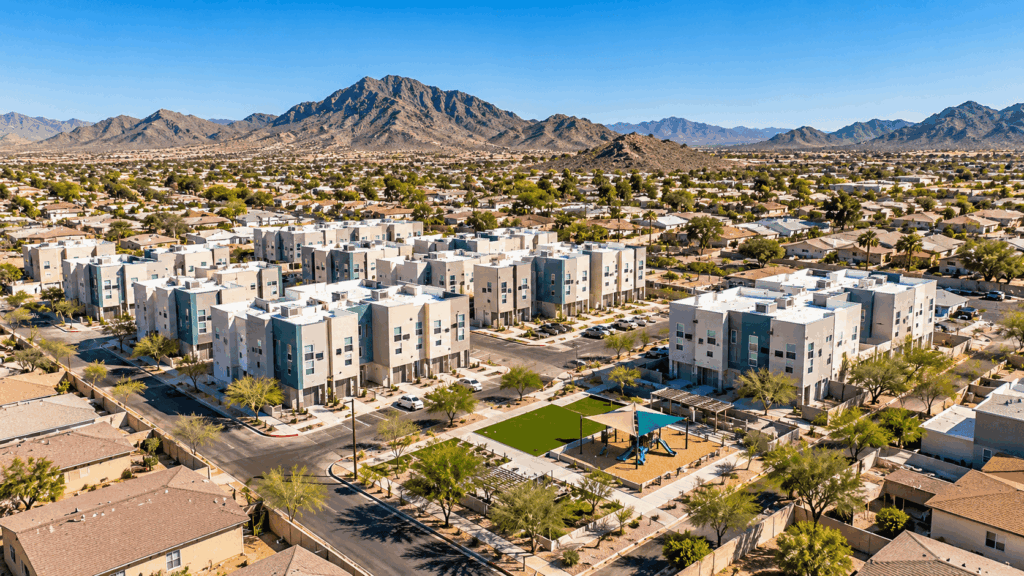
The Connection Between Housing, Employment, and Economic Growth
A growing community needs more than new businesses, expanding infrastructure, and commercial investment. It also needs housing that allows the people supporting its economy to live and work locally.
Across Arizona, workforce housing development has become an important consideration for communities seeking sustainable economic growth. As housing costs rise relative to local wages, employees in essential industries may struggle to find homes within a reasonable distance of their workplaces.
Teachers, healthcare professionals, hospitality employees, construction workers, public safety personnel, and other working households all contribute to the daily functioning of a community. When housing options do not align with their incomes, the consequences can extend far beyond the residential real estate market.
For developers, workforce housing presents an opportunity to address a practical community need while creating residential properties designed around long-term demand.
At APX West, we recognize that successful real estate development is about more than constructing buildings. It is about creating properties that support the people, businesses, and economic activity that make communities thrive.
What Is Workforce Housing?
Workforce housing generally refers to homes intended to be financially accessible to working households whose incomes may be too high to qualify for certain subsidized housing programs but insufficient to comfortably afford available market-rate homes.
Unlike housing programs tied to a specific federal income threshold, the definition of workforce housing can vary by community.
A home considered attainable in one Arizona market may be out of reach for workers in another, depending on local wages, property values, and household expenses.
This is why attainable housing must be evaluated in the context of the local economy.
Developers need to understand what residents earn, what they can reasonably afford, and which housing types are most appropriate for the area.
Workforce housing solutions may include smaller single-family homes, townhomes, multifamily residences, or efficiently designed neighborhoods that prioritize functionality and affordability.
The objective is to deliver quality housing at price points that reflect the purchasing power of the people who live and work in the community.
1. Workforce Housing Helps Local Businesses Attract and Retain Employees
Housing availability directly influences a region’s ability to support employers.
When workers cannot find suitable homes near their jobs, businesses may experience greater difficulty recruiting and retaining employees.
Long commutes, high housing expenses, and limited residential options can make otherwise attractive employment opportunities less practical.
For industries that depend on a reliable local workforce, these challenges can affect staffing, productivity, and operating costs.
Communities with a more balanced housing supply may be better positioned to support business expansion because employees have more options for establishing long-term roots.
This relationship is particularly relevant in markets where tourism, healthcare, construction, retail, and service industries contribute significantly to local employment.
Workforce housing development can help address these needs by introducing residential options that align more closely with the economic realities of local workers.
2. Attainable Housing Supports Long-Term Community Stability
A community becomes more resilient when residents have opportunities to live near their workplaces, schools, and essential services.
When housing becomes increasingly inaccessible, working households may be forced to relocate farther away or leave the area entirely.
This can create challenges for employers, schools, healthcare providers, and local businesses.
Attainable housing contributes to community stability by supporting a more diverse range of residents and household incomes.
It can also help workers remain connected to their neighborhoods as their careers and families evolve.
The importance of housing affordability is reflected in national research from the Harvard Joint Center for Housing Studies, which examines housing costs, affordability challenges, and broader housing market conditions.
For developers, understanding these pressures is essential when evaluating the type of housing a community needs.
A successful residential development should respond to more than aesthetic preferences. It should consider how the finished homes will function within the local economy.
3. Housing Affordability Can Influence Regional Economic Development
Housing and economic development are closely connected.
When a region attracts new businesses, the resulting employment opportunities can increase demand for nearby homes.
However, if residential construction does not keep pace with workforce needs, housing affordability may become a constraint on future growth.
Employers considering expansion often evaluate factors beyond commercial property availability. They may also consider labor supply, transportation access, and the cost of living for prospective employees.
A community that offers employment opportunities but lacks attainable housing may face challenges sustaining its growth.
This makes workforce housing an important component of broader economic planning.
Developers, municipalities, employers, and infrastructure providers all play roles in creating an environment where residential and commercial development can support one another.
Rather than viewing workforce housing as an isolated residential category, it can be understood as part of the infrastructure that supports a functioning regional economy.
4. Why Delivering Workforce Housing Is Challenging
Although the need for attainable housing is clear in many markets, delivering it can be financially complex.
Developers face many of the same expenses regardless of whether they are constructing luxury residences or more moderately priced homes.
Land acquisition, engineering, infrastructure, permitting, financing, labor, and materials all contribute to the total development cost.
Certain expenses, such as utility connections or site preparation, may not decrease proportionally when a smaller or less expensive home is built.
This creates a challenge: the finished home must be priced within reach of its intended buyers while still supporting the cost of development.
Other obstacles can include zoning restrictions, minimum lot sizes, infrastructure limitations, and construction financing requirements.
In some locations, land suitable for residential development may be limited or expensive, further reducing the feasibility of lower-priced housing.
Addressing these challenges requires disciplined planning and careful coordination across the development process.
Through our real estate planning services, APX West evaluates site characteristics, land use opportunities, and development requirements with an emphasis on creating practical, financially informed projects.
5. Efficient Design Can Help Make Homes More Attainable
One of the most effective ways to manage workforce housing costs is to make thoughtful design decisions before construction begins.
Efficient floor plans can reduce unnecessary square footage while preserving the features homeowners value most.
Open living areas, functional kitchens, adequate storage, comfortable bedrooms, and practical outdoor spaces can create appealing homes without requiring excessive building size or complicated architectural details.
Standardized floor plans and carefully selected materials may also help reduce construction complexity.
By limiting unnecessary customization and coordinating purchasing decisions, developers can create more predictable construction processes.
However, affordability should not come at the expense of essential quality.
Durable materials, reliable building systems, energy efficiency, and sound construction practices remain important because they influence maintenance expenses and long-term homeownership costs.
The goal is to eliminate inefficiency, not compromise the functionality or longevity of the finished home.
6. Infrastructure Planning Plays a Critical Role
The cost of preparing land for residential construction can significantly influence the final price of workforce housing.
Roads, utilities, drainage systems, grading, and other site improvements must be incorporated into the development budget.
For larger residential communities, these expenses are often distributed across the number of finished lots or homes.
Efficient site planning can help developers evaluate lot configurations, road layouts, utility routes, and grading strategies to determine how infrastructure can be delivered economically.
For example, a thoughtfully designed subdivision may reduce unnecessary roadway length or avoid grading solutions that introduce excessive construction costs.
These decisions require collaboration between planners, engineers, and construction teams.
Our engineering services support the technical evaluation of development sites, helping connect infrastructure requirements with practical construction strategies.
Early engineering involvement can be especially valuable in desert environments, where topography, drainage, and utility access may substantially affect the cost of finished lots.
7. Workforce Housing Must Reflect Local Market Conditions
There is no universal formula for successful workforce housing development.
The appropriate home size, price point, and community design depend on local employment patterns, household incomes, available inventory, and buyer preferences.
A housing solution that works in a large metropolitan area may not be appropriate for a smaller Arizona community.
Developers should study comparable home sales, income data, demographic trends, and existing residential supply before determining what to build.
The U.S. Department of Housing and Urban Development publishes income limit data that can provide useful context when evaluating household income levels and housing affordability.
However, developers must also consider actual mortgage affordability, insurance, property taxes, and other ownership expenses.
A home’s purchase price is only one part of its total cost to the buyer.
Successful workforce housing solutions should reflect what local households can realistically sustain over time.
8. The Role of Coordinated Construction in Controlling Costs
Construction efficiency is another important factor in delivering attainable homes.
When development teams coordinate planning, engineering, procurement, and construction early, they may identify opportunities to reduce unnecessary expenses and avoid costly revisions.
Repeated floor plans, consistent material specifications, realistic schedules, and coordinated subcontractor management can all contribute to more predictable project execution.
These efficiencies become particularly meaningful when multiple homes are constructed within the same development.
A coordinated approach also helps ensure that cost-saving decisions made during design remain practical during construction.
At APX West, our construction services (https://apxwest.com/what-we-do/construction/) emphasize the importance of aligning project execution with development objectives, budgets, and quality expectations.
For workforce housing, this alignment is essential because maintaining financial discipline can directly affect whether the completed homes remain attainable for their intended buyers.
9. Workforce Housing as a Long-Term Development Opportunity
Workforce housing is not simply a response to short-term affordability concerns.
In communities with stable employment and ongoing demand for residential properties, it can represent an important segment of the broader housing market.
Developers who understand local workforce needs may identify opportunities to create housing that serves an established buyer population.
However, the financial feasibility of each project must be evaluated independently.
Strong community need does not automatically guarantee sufficient sales prices, financing availability, or attractive investment returns.
Successful projects require careful land acquisition, realistic construction budgets, market research, and a clear understanding of the intended buyer.
When these factors align, workforce housing can contribute to both community development and responsible real estate investment.
Building Communities That Work for Everyone
The future of growing Arizona communities depends on more than attracting businesses and constructing new commercial properties. It also depends on providing homes for the people who keep those communities operating.
Workforce housing development plays an important role in supporting employers, strengthening neighborhoods, and creating a more balanced residential market.
At APX West, we approach development with a commitment to understanding local needs, evaluating opportunities strategically, and delivering projects that contribute to long-term community value.
Looking to explore a residential development opportunity or understand how attainable housing can fit into your investment strategy? Contact APX West to discuss how our planning, engineering, and construction expertise can help bring a thoughtfully designed project from concept to completion.